
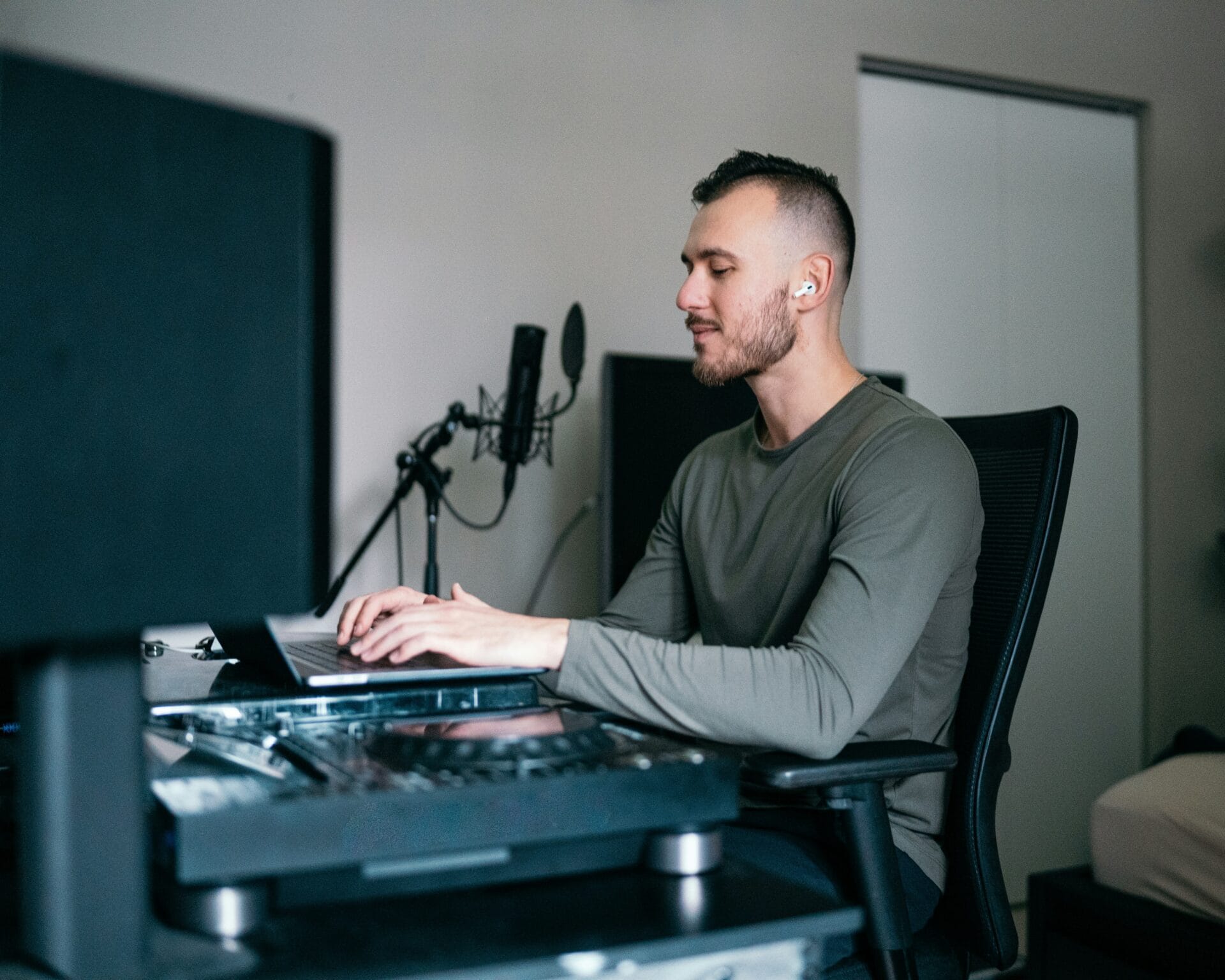
Thinking about building your own home studio? Great—you’ve already taken the first step! Now it’s time for a plan. The key is understanding exactly what you need, and that’s where we come in. Whether you’re a beginner or looking to upgrade your setup, having a clear list of recommendations can make all the difference. In this guide, we’ll break down the essential gear you need and provide key factors to consider when making your choices.
Here’s the thing… If you ask ten musicians for gear recommendations, you’ll get ten different answers. So in this article, we’re covering the categories of gear along with a few specific options to get you pointed in the right direction. Let’s do it!
1. Computer: The Foundation of Your Studio
Your computer is the backbone of your recording setup, so it needs to be powerful enough to handle recording, editing, and mixing without lag.
- Processor: Aim for at least an Intel i5 or AMD Ryzen 5, though an i7 or Ryzen 7 (or higher) is preferable for larger or more demanding projects.
- RAM: A minimum of 8GB is required, but 16GB or more will ensure smooth performance.
- Storage: Solid-state drives (SSD) provide faster data access, reducing load times and improving overall performance.
- Mac vs. PC: Both platforms work well for music production. The key factor is ensuring your chosen DAW is fully compatible with your system.
2. Digital Audio Workstation (DAW): The Heart of Your Studio
Your DAW is the software you’ll use to record, edit, and mix your music. Popular choices that we recommend are:
Ultimately, the “best” DAW is the one you feel comfortable using. Sound quality is virtually the same across platforms—it’s more about workflow, compatibility with your hardware, and personal preference.
3. Audio Interface: Bridging the Analog and Digital Worlds
An audio interface converts analog signals (like your voice or instruments) into digital data your computer can process. When choosing an interface, consider:
- Number of Inputs/Outputs: If you record multiple instruments simultaneously, you’ll need more inputs.
- Preamp Quality: High-quality preamps deliver cleaner, clearer sound.
- Connectivity: Make sure the interface works seamlessly with your computer—USB, Thunderbolt, and PCIe are common options.
Recommended Brands
- Universal Audio (UAD): Offers a wide range of interfaces, from affordable to high-end, with exceptional preamps and DSP power.
- Other trusted brands include Apogee, MOTU, and SSL.
4. Microphones: Capturing the Right Sound
Choosing the right microphone depends heavily on what you’re recording.
- Dynamic Microphones: Durable and great for loud sources like vocals, guitar amps, and drums. Examples: Shure SM57, Shure SM7B.
- Condenser Microphones: Capture more detail and are ideal for vocals and acoustic instruments. Examples: RØDE NT1, Neumann TLM 103.
- Ribbon Microphones: Known for their warm, vintage sound, but they are delicate and require careful handling.
Understanding Polar Patterns
- Cardioid: Focuses on sound from the front, reducing background noise.
- Omnidirectional: Captures sound evenly from all directions—great for capturing room ambience.
5. Studio Headphones: Precision Listening
Headphones are essential for both monitoring during recording and detailed mixing.
- Closed-Back Headphones: Best for recording, as they prevent sound leakage into your microphone.
- Open-Back Headphones: Offer a more natural sound, making them ideal for mixing (in quieter environments).
Recommended Brand
- Budget Option: Audio-Technica ATH-M30x – Affordable and reliable for tracking.
- Pro Option: Audeze LCD-X – Top-tier clarity, but very expensive (and frankly overkill for most home studios).
What you actually need: For monitoring, an affordable option works perfectly well. Save the bigger investment for monitors or microphones if budget is a concern.
6. Studio Monitors: Hearing Your Mix Accurately
Unlike regular speakers, studio monitors provide a flat frequency response, giving you an accurate picture of your mix.
- Monitor Size: In smaller rooms, 5-inch monitors are usually sufficient. For larger rooms, 8-inch models can provide better bass response.
- Placement & Acoustic Treatment: Position monitors at ear level and add acoustic treatment to minimize unwanted reflections.
Recommended Brand
We’ve used Ocean Way Audio monitors for years and we highly recommend them. They offer models for every budget, from affordable to high-end. If you’re interested in purchasing, contact us directly for exclusive deals and pricing options.
7. Soundproofing & Acoustic Treatment: Better Sound, Better Recordings
Soundproofing: Let’s Clear the Confusion
There’s a common myth that foam panels, curtains, or decorative acoustic panels can “soundproof” a room. This is not true. Soundproofing is fundamentally a construction process—it requires physically altering walls, doors, and windows to block external noise.
If you want true sound isolation, you need to consider:
- Building double walls or decoupled structures.
- Adding mass to walls with materials like drywall, mass-loaded vinyl, or dense insulation.
- Sealing gaps around doors and windows.
Acoustic Treatment: Shaping Your Room’s Sound
Acoustic treatment focuses on improving internal sound clarity by reducing reflections, flutter echoes, and bass buildup. This is where bass traps, diffusers, and acoustic panels come into play.
Our Recommendation
If you need high-quality acoustic panels, we offer professional-grade solutions at competitive prices. You’ll find everything you need directly through us—no need to look elsewhere!
Ready to Build Your Studio?
Choosing the right gear isn’t just a formality—it’s the foundation for bringing your passion to life right in your own home. Need help designing or optimizing your space? Let’s talk—we’re here to offer expert guidance, personalized gear recommendations, and help you design a space that works for you.
Get your setup right, and your studio won’t just sound good—it’ll be the place where your biggest ideas explode into reality.
Happy recording!