

Why the sound of your restaurant is just as important as the food you serve.
When you imagine the perfect atmosphere in your restaurant, you probably picture the lighting, the aroma from the kitchen, the layout of the tables, the energy of the staff. But without a well-balanced acoustic environment, each of these struggle to shine.
Sound isn’t a small detail—it’s a defining part of the experience. Too much reverberation forces guests to raise their voices, creates confusion, and undermines the relaxed, curated vibe every restaurateur works hard to achieve. A well-treated acoustic environment, instead, allows conversations to flow effortlessly, helps staff communicate clearly, and makes the whole space feel more comfortable and refined.
The “Noise Cycle” in Restaurants & Why It Needs to Be Stopped
Most modern restaurants, especially those designed with clean lines, glass, concrete, tiles, and open volumes, naturally generate reverberation. Sound waves bounce off reflective surfaces and accumulate faster than they dissipate.
This activates what acousticians call the Lombard effect—the automatic human behavior of speaking louder in noisy environments. The result is a constant upward spiral: more noise → louder voices → more noise.
The goal isn’t to create a silent room; a restaurant needs energy. The goal is controlled sound: where liveliness remains but chaos disappears.
Soundproofing vs. Acoustic Treatment: A Critical Distinction
Many people confuse these two concepts but they serve completely different purposes:
- Soundproofing is about preventing sound from entering or leaving a space. It requires mass, construction, isolation systems, acoustic doors, soundproof windows, multi-layered drywall, sealing, etc.
- Acoustic treatment is about improving the sound inside a space—reducing reverberation, increasing speech clarity, and balancing the room’s energy. This is done with acoustic panels, baffles, and suspended absorbers.
For a clear and reliable explanation, read our more detailed article.
And to be completely accurate: acoustic panels do not soundproof a room. If unwanted sound is entering or leaving the space, the solution lies in the building envelope as a whole—properly constructed walls, as well as acoustic doors and windows—not interior panels.
This distinction protects expectations and reinforces professionalism.
What Materials Actually Work & Why
The effectiveness of acoustic treatment comes from the physics of absorption and resonance. The best tools are materials with predictable, certified, and reliable acoustic behavior. Here are the professional solutions commonly used in hospitality design.
High-Density Fibrous Materials (PET Felt, Compressed Fibers, Architectural Absorbers)
Recycled PET is one of the most widely used materials in modern acoustic panels. Its internal structure slows and dissipates sound energy, particularly in the mid-range frequencies—the range of human speech. It’s lightweight, sustainable, visually elegant, and available in countless shapes and colors.
These are part of the family of “porous absorbers.”
Perforated Wood Panels with Acoustic Substrate
Perforated wood panels provide a beautiful combination of:
- Diffusion, through the perforated pattern
- Absorption, through the inner acoustic core
Many operate using the Helmholtz resonance principle—an elegant physical mechanism that attenuates specific frequency bands. This results in a warm, controlled, premium acoustic texture.
Suspended Elements & Vertical Baffles
Unlike wall panels, suspended solutions absorb sound from both sides, doubling the effective absorption area. They are ideal in restaurants with high ceilings or many reflective surfaces.
All Acoustic Panels Should Have an NRC Rating
NRC (Noise Reduction Coefficient) quantifies how much sound a material absorbs. Panels without NRC certification offer no predictable performance—an essential point every restaurant owner should know.
Foam is not recommended. Acoustic foam is common in amateur or low-budget setups but is not appropriate for restaurants. It degrades quickly, looks unrefined, and performs worse than PET or other acoustic products. To align with the company’s philosophy, we don’t recommend it.
Where Treatment Makes the Biggest Impact Inside a Restaurant
Acoustic treatment is not about covering every surface. The best results come from a strategic approach.
The ceiling is typically the number one priority. It reflects the most sound and is the hardest surface for conversations to “escape.” Suspended panels and baffles deliver uniform, room-wide improvements.
Large wall surfaces are the next target—adding decorative or modular absorption can dramatically reduce harsh reflections while enhancing the space’s design.
High-noise zones like bar areas, entryways, and corridors often amplify sound unintentionally. Treating these hotspots improves the entire ambience.
Even “difficult” rooms (such as spaces with hard materials or even basement-level rooms) can become acoustically excellent with proper treatment. There is no such thing as a “bad” room; only a room that hasn’t been treated yet.
Acoustic Panels as Part of Your Restaurant’s Identity
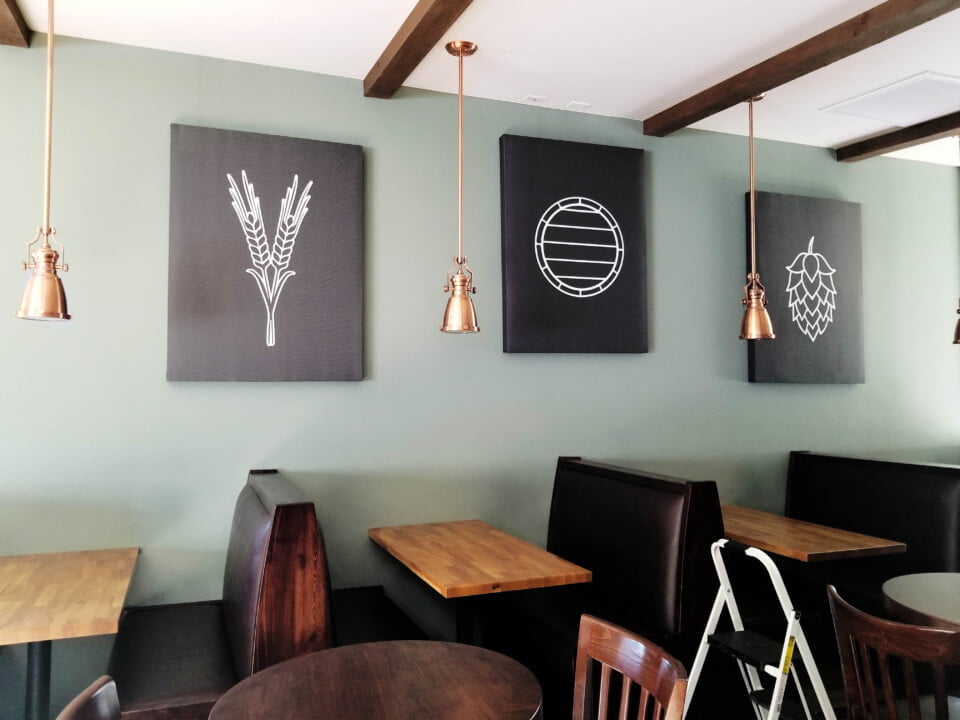
Modern hospitality design no longer hides acoustic treatments. Panels are now part of the visual language—geometric patterns, soft textures, color-blocked compositions, suspended sculptures.
Baffles can also become a statement element: Acoustic Polyester Baffles come in a range of colors and configurations, making them both a performance asset and a visual design feature.
A restaurant with curated acoustics doesn’t just sound better. It looks more refined, feels more premium, and communicates care and intentionality.
Guests notice it, even if they can’t articulate why.
A Restaurant that Sounds Good Feels Good
Acoustics aren’t a technical afterthought; they are a core element of guest experience. Good acoustic treatment makes conversations easier, the atmosphere more pleasant, the staff less stressed, and the overall impression undeniably higher-quality.
If you’d like to explore professional acoustic panels, baffles, and decorative treatment options for restaurants, you can find a list of products on our website.From the heart of Austin to the pulse of LA, we shape restaurants and commercial spaces that sound as good as they look. Get in touch.