
A busy office has its own soundtrack: conversations, phone calls, keyboards, video meetings, HVAC systems, footsteps, and the occasional coffee machine. None of these sounds is unusual on its own. The problem starts when they combine in a space that allows sound to reflect and travel too easily.
Good office acoustics are about creating an environment where people can communicate when they need to, concentrate when they need to, and get through the workday without constantly fighting the room around them. Research increasingly connects the acoustic environment with concentration, perceived productivity, comfort, and wellbeing.
Why Office Noise Is So Distracting
Not all noise affects us in the same way. In an office, one of the biggest distractions is often speech.
A conversation happening several desks away may not be particularly loud, but if you can clearly understand the words, your brain has a hard time ignoring them. That makes speech especially disruptive during tasks involving writing, reading, analysis, or other forms of focused work.
A study of 1,078 workers in shared and open-plan offices found that irrelevant speech from conversations, phone calls, and similar sources was associated with greater noise annoyance and perceived reductions in work performance. The effects were more pronounced in open-plan offices.
Another longitudinal study examining workers who moved from private offices to an open-plan environment found increased distraction, concentration difficulties, reduced speech privacy, and greater use of coping strategies after the move.
This helps explain why an office does not need to feel extremely loud to have an acoustic problem. Intelligible conversations traveling across the room can be more distracting than a steady background sound.
Office Acoustics & Employee Wellbeing
Acoustic comfort also matters beyond productivity.
The World Health Organization’s guidance on noise notes that excessive noise can interfere with daily activities, reduce performance, provoke annoyance, and contribute to broader health effects.
Office noise is generally very different from the high sound levels associated with occupational hearing damage. Still, lower-level noise can be tiring and stressful when it is persistent or difficult to escape. The WHO also notes that noise below levels associated with hearing damage may still contribute to annoyance and increased stress in work environments.
Think about spending eight hours in a room where every phone conversation carries, meeting-room voices spill into nearby workstations, and hard surfaces keep sounds bouncing around. Even when employees cannot identify a single “loud” source, the accumulated acoustic activity can make the space feel restless and mentally demanding.
Why Modern Offices Can Be Acoustically Challenging
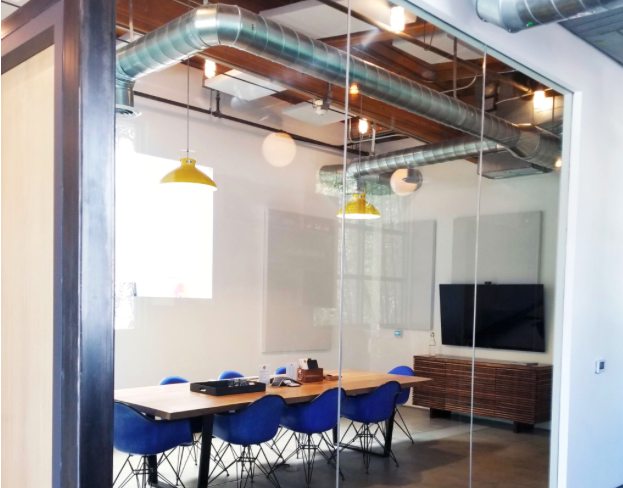
Many contemporary offices favor open layouts, glass walls, exposed concrete, large windows, hard flooring, and minimal interiors. Visually, these spaces can look clean and spacious. Acoustically, they may present a challenge because many of those surfaces reflect rather than absorb sound.
When sound hits a hard surface, part of its energy is reflected back into the room. With enough reflective surfaces, those reverberations persist and overlap, increasing in intensity and allowing activity in one part of the office to affect people elsewhere.
The goal is not to make an office completely silent. An unnaturally dead workspace can create its own problems, including making nearby conversations feel more exposed. Instead, acoustic design should support the activities happening in each part of the space.
The U.S. General Services Administration’s facilities standards for open-plan offices similarly emphasize engineered acoustic design, including sound-absorptive surfaces and access to acoustically private enclosed spaces.
Improving Office Acoustics Starts With the Room
Before adding treatment, it helps to identify where the problems actually occur.
A collaborative area may tolerate more activity than a space where people write reports or analyze data. Conference rooms need speech clarity inside the room, while private offices may require greater attention to speech privacy between spaces. Reception areas, cafeterias, call-heavy departments, and shared workstations each behave differently.
Useful questions include:
- Where are employees struggling most with concentration?
- Are conversations carrying much farther than they should?
- Do meeting rooms sound echoey or make remote calls difficult to understand?
- Are large areas dominated by glass, concrete, drywall, or other reflective surfaces?
- Are quiet tasks positioned directly beside collaborative or high-traffic areas?
These observations help determine where absorption and other acoustic strategies will have the greatest effect.
How Acoustic Panels Help
Professional acoustic panels add absorption to surfaces that would otherwise reflect sound back into the room. By controlling reflections and reducing excessive reverberation, panels can make speech and everyday office activity feel more controlled.
Placement matters. Depending on the room, treatment may be useful on walls, ceilings, or both. Large offices with limited wall space may require a different approach from enclosed conference rooms or executive offices.
Product performance matters as well. When comparing acoustic panels, look for credible test data rather than relying only on appearance or vague claims about “noise reduction.”
One common metric is NRC, or Noise Reduction Coefficient, which summarizes sound absorption performance across specified frequencies. ASTM C423 describes the standardized reverberation-room method used to measure sound absorption coefficients for materials and objects.
Professional treatment can also be integrated into the visual design of an office, allowing panels to function as architectural or decorative elements instead of looking like an afterthought.
Acoustic Treatment Is Not Soundproofing
There is an important distinction when planning an office project.
Acoustic panels control sound behavior within a room. They are designed to absorb reflections and manage reverberation. They should not be expected to stop sound from traveling through walls, doors, windows, ceilings, or other building elements.
If the problem is a confidential conversation being clearly heard through the wall of a neighboring office, the solution may require changes to the construction itself. True sound isolation can involve wall assemblies, added mass, insulation, decoupling, sealed penetrations, sound-rated doors, or specialized windows.
For a more detailed explanation, see this guide to the difference between soundproofing and acoustic treatment.
Designing an Office That Sounds Better to Work In
Good office acoustic design does not require eliminating every sound. It requires controlling the room so that sound supports the work happening there instead of constantly competing for attention.
That may mean reducing excessive reflections in a conference room, controlling reverberation across an open workspace, or creating more comfortable acoustic conditions in areas intended for focused work.
If your workplace feels louder, more echoey, or more distracting than it should, professional treatment can make a meaningful difference. Explore Better Sound’s professional acoustic solutions or contact the team for help choosing treatment suited to your office and the way people actually use it.