

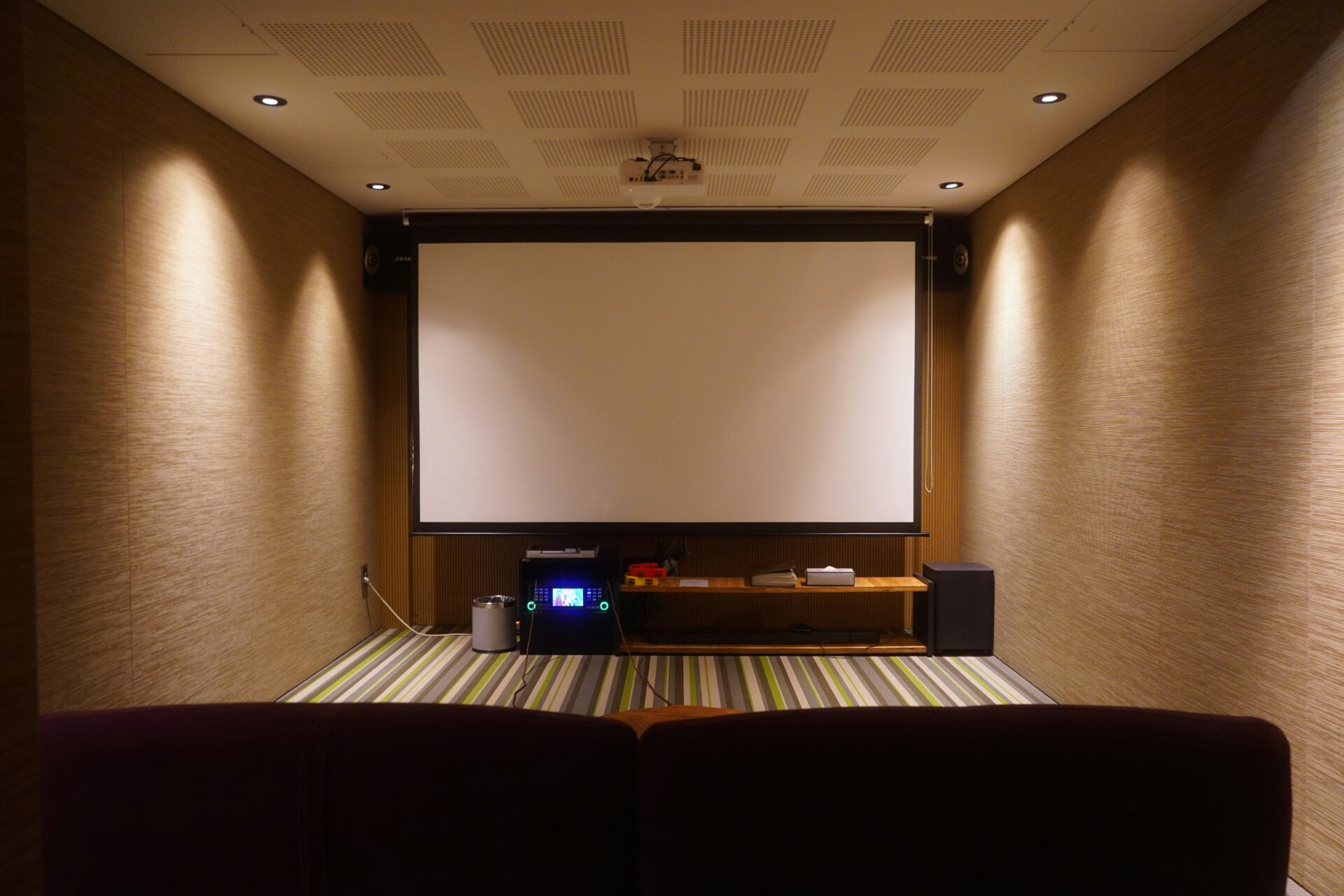
As autumn arrives and the days grow shorter, home becomes the perfect refuge for experiencing powerful emotions in front of the screen. It’s the season when many begin to look at their entertainment spaces with fresh eyes, dreaming of a more immersive and captivating experience.
But upgrading your home theater doesn’t necessarily mean buying the latest TV or a cutting-edge surround sound system. The real magic often lies in something as invisible as it is powerful: the acoustics of the room. Optimizing it is one of the most underrated (yet most effective) ways to transform every viewing session into a truly cinematic experience.
Why Acoustics Matter More Than Equipment
You can own a state-of-the-art sound system, but if your room has poor acoustics, your experience will suffer. Echoes, muddied dialogues, uneven bass. These are all symptoms of a space that’s interacting badly with sound.
The good news? These issues aren’t a reflection of your equipment. They’re caused by the way sound behaves in untreated spaces. And this is where acoustic treatment (not to be confused with soundproofing) comes in.
One of the key acoustic metrics to consider in a home theater environment is RT60, the time it takes for sound to decay by 60 decibels in a space after the source has stopped. For home cinemas, an ideal RT60 typically falls between 0.3 and 0.6 seconds, which helps preserve clarity (especially for dialogue) while maintaining a sense of fullness without making the room feel overly “dead.”
Another essential concept is the Noise Reduction Coefficient (NRC), a measure from 0 to 1 that quantifies how much sound a material can absorb. For example, an NRC of 0.8 means the panel absorbs 80% of the sound energy that hits it. This metric helps consumers and professionals alike select the right materials for each frequency range.
What Materials Really Work & Why
There are plenty of “acoustic” products on the market but not all are effective. Common pyramid foam, for instance, is often visually dramatic but performs poorly below 1,000 Hz. In contrast, denser materials—like mineral wool, compressed fiberglass, or high-density PET felt—offer broader-band absorption, including mid and low frequencies that matter most for home cinemas.
One of the critical reasons we rely on thick, porous absorbers (especially in corners) is their ability to tame room modes that would otherwise leave you with boomy, uneven bass or void-like “holes” in your low end. Room modes are resonances that naturally occur between parallel surfaces and are often concentrated in the bass region, causing drastic peaks and dips in the sound response, sometimes as much as 20 dB or more. Using deep absorbers like bass traps in corners helps address these problematic modes effectively, since corner placement can engage all major modes in a rectangular room.
And not everything needs to be absorbed. In fact, if you over-treat a room with only absorptive surfaces, you risk losing spaciousness and natural ambiance. This is where diffusion becomes valuable. Diffusive panels scatter sound in many directions, helping preserve a sense of space and dimensionality. They’re especially effective on the rear wall behind the listener, where direct reflections can otherwise be distracting.
Positioning Panels: Strategy, Not Guesswork
The goal of acoustic treatment isn’t to cover every inch of your walls, it’s to control key reflection points. The most influential of these are known as the first reflections, the points on your side walls and ceiling where sound from your speakers bounces directly into your ears.
To locate them, a common trick used even in professional studios is the “mirror method.” While sitting at the main listening position, have someone move a mirror along the side walls. Wherever you can see the speakers in the mirror is where a reflection would hit, making it the perfect spot for an acoustic panel.
Corners, as mentioned, are the natural home for bass traps. Sound builds up where boundaries meet, especially at low frequencies. Corner traps help manage these build-ups, flattening the low-end response and removing that unwanted boominess.
The ceiling is often overlooked, but it’s a large reflective surface, especially if you’re sitting close to it, as in smaller rooms. Installing a suspended acoustic “cloud” above the seating area can minimize early reflections and improve dialogue intelligibility.
And then there’s the rear wall, which (when left untreated) can cause delayed reflections and listener fatigue. Here, a combination of broadband absorption and diffusion often delivers the best results.
What About Immersive Audio Systems?
With the rise of Dolby Atmos, DTS:X, and Auro-3D, many home theater setups now feature overhead and height channels. These add a vertical dimension to the soundstage but also add complexity to the room’s acoustic behavior.
Dolby themselves recommend that immersive systems be paired with acoustically neutral rooms, where reflections are controlled but not eliminated. If you’re planning an Atmos buildout, it’s especially important to reduce early reflections while preserving a natural sense of envelopment, a goal best achieved through strategically placed absorption and selective diffusion.
Sound Treatment vs Soundproofing: Know the Difference
A common misconception is that acoustic panels will stop sound from leaking in or out of a room. They won’t. Soundproofing (the act of blocking sound transmission) involves heavy mass (like multiple layers of drywall), decoupling methods (like resilient channels), and sealing air gaps. It’s a construction project.
A critical distinction to understand in acoustic design is that acoustic treatment focuses on controlling sound inside the room—reducing echo and managing reflections to improve clarity and warmth. In contrast, soundproofing is all about preventing sound from passing through the room boundaries requiring more structural approaches like building mass, decoupling elements, or specialized seals. Soundproofing controls what sound enters or leaves a space, while acoustic treatment controls how sound behaves within the space.
A Smarter Way to Build Your Room
Many professionals suggest starting small and expanding. Focus first on taming the most damaging reflections (side walls, ceiling, and corners) then add diffusion once the room’s decay time is under control.
The science backs this up: a well-treated room elevates everything—your gear, your movies, your experience.
A better-sounding room doesn’t require a construction crew or endless trial and error. With the right materials, the right placement, and a little know-how, your home theater can truly sound like a cinema.
If you’re thinking about designing your own home theater, visit bettersound.com.