

Enhancing modern spaces through sound, material, and design
In recent years, acoustic panels have undergone an interesting transformation from “a technical thing added at the end” to a true interior design element, meant to be designed together with the space itself. Today, they can be used to create warmer atmospheres, more livable environments, clearer conversations, and a more immersive listening experience, without compromising aesthetics. In fact, they often enhance it.
Professional acoustic panels are no longer technical solutions to be hidden away. They have become design tools, capable of improving acoustic comfort while simultaneously reinforcing the visual identity of a space. Whether it’s a private home, a hospitality venue, or a creative environment, the way a space sounds directly affects how it is perceived and experienced.
In the following sections, we’ll explore several creative ideas for integrating acoustic solutions in an aesthetic and architectural way, turning them into a true design choice.
Creative Ideas for Integrating Acoustic Panels in an Aesthetic & Architectural Way
How can acoustics stop feeling like an add-on and become a design decision?
1) Full-surface textile walls: premium look, maximum performance
If you’re aiming for an ultra-clean, contemporary, almost “gallery-like” effect, one of the most elegant solutions is a wall with a continuous fabric finish (such as a fabric track system). It’s ideal when you want to:
- Achieve visual uniformity (no visible frames)
- Cover niches, corners, or complex geometries
- Create a large surface that genuinely works on reverberation
This approach works particularly well in lobbies, meeting rooms, home cinemas, creative studios, and high-end residential spaces.
2) Fabric-wrapped panels as modular artworks (with real acoustic purpose)
Looking for a more dynamic effect? Fabric-wrapped panels, custom-made in shape and size, are the most versatile option. Ideas that always work:
- Geometric grids (ordered, minimal, architectural)
- Asymmetric compositions (more artistic, more “boutique hotel”)
- Tone-on-tone with the wall (discreet, ultra-premium effect)
- Bold contrast (an accent wall with acoustic function)
The key is to treat them as a “material,” not an “accessory:” same palette, same rhythm, same proportional logic as the rest of the interior.
3) Wood slats: visual warmth + adjustable performance
Slatted wood acoustic panels have become a true aesthetic language. They add texture, depth, and an immediate sense of quality, making them a natural choice in contemporary interiors.
What makes them especially interesting is that their acoustic performance is highly adaptable and depends on how they are designed and installed. Factors such as slat spacing, panel depth, and, crucially, the type and thickness of the acoustic absorber placed behind the slats play a decisive role. This is not just decoration, but a system whose effectiveness grows with thoughtful configuration.
In practice, integrating a dedicated acoustic backing behind the slatted surface allows these panels to move from purely reflective elements to highly effective acoustic solutions. Increasing the thickness of the absorber behind the slats significantly enhances sound absorption, particularly in the mid and low frequencies, resulting in a much more balanced and comfortable acoustic environment.
For this reason, manufacturers often report a wide range of NRC values for slatted wood panels. Geometry, depth, and backing materials all influence the final result, which means performance is not a fixed number, but something that can be tuned to the needs of each project. This flexibility makes wood slat systems especially well suited to design-led spaces where aesthetics and acoustic performance must work together.
4) Acoustic baffles: acoustic control for large volumes, with a light aesthetic
In open spaces, restaurants, high ceilings, or highly reflective environments, ceiling baffles are often the smartest move. Why?
- They intervene directly in the upper portion of the space, where sound tends to persist longer in large, reverberant rooms
- They don’t take up wall space (useful with glass, furniture, or artwork)
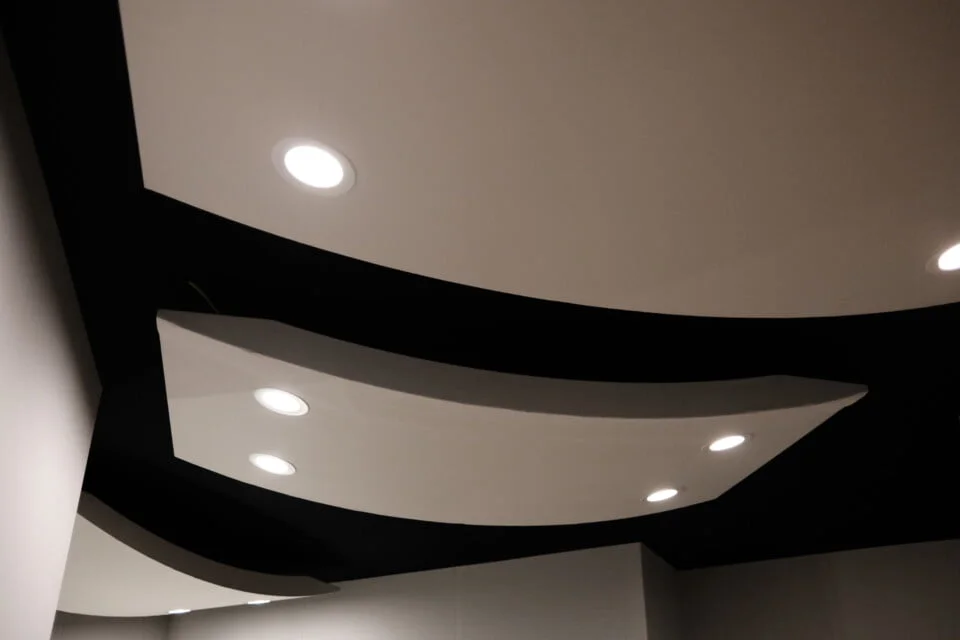
- They can become a sculptural element: parallel lines, patterns, suspended “clouds”
They’re also ideal when you want a clean, modern look, using materials like certified polyester (lightweight, tidy, quick to install). Here, acoustics can truly become a “design language,” not just a corrective measure.
5) Diffusers: when you want natural sound without “deadening” the space
Absorption isn’t always the goal. In critical listening spaces (studios, carefully designed home cinemas, music rooms), diffusion helps maintain a more natural, spacious sound, reducing problematic reflections without making the room feel “dead.”
This is where elements like diffusers come into play, often available in wood, with a distinctly architectural aesthetic.
Ideas for Specific Environments
Home theater & media rooms: dialogue clarity is everything
A useful parameter here is RT60 (reverberation time). In a well-designed home cinema, many technical references suggest values around 0.3–0.6 seconds to preserve clarity and immersion. An NTi Audio application note specifically mentions this range for medium-sized home theaters.
In practical terms: panels + diffusion (in the right places) = clearer dialogue, more precise effects, and a more “cinematic” experience.
Home music studios: not just for professionals
In recording and mixing, the goal is an environment that doesn’t “lie” to you. What matters is the combination: targeted absorption, low-frequency control, and management of early reflections. The Audio Engineering Society is a long-standing reference when it comes to listening-room treatment and control.
Podcast & creator rooms: acoustics that look good on camera
Here the demand is twofold: clean voice + camera-ready style. Fabric panels in a coherent palette, clean layouts, and a few “signature” elements (a pattern, a composition, an invisible frame) instantly make the set feel more professional, even on video.
Acoustics as Part of the Spatial Experience
A space can look visually perfect and still feel tiring, unwelcoming, or difficult to use. Excessive echo and reflections make conversations exhausting, increase background noise, and lower the overall quality of the experience.
Numerous studies in architectural and environmental fields show that sound control directly contributes to well-being, concentration, and comfort—especially in shared spaces. It’s no coincidence that platforms like ArchDaily increasingly describe acoustics as a true design material, on par with light or surfaces.
In this context, acoustic panels become an integral part of architectural language, not a last-minute addition.
Designing What You Can’t See
Investing in acoustic panels means going beyond simple sound improvement; it means transforming how a space functions, how it is perceived, and how it is lived. This isn’t about improvised solutions or unrealistic promises of “easy soundproofing” but about the right materials, conscious design, and reliable performance over time.
A well-integrated acoustic project makes a space coherent in every aspect: light, materials, proportions, and sound. Whether residential, hospitality, or professional, acoustic quality is what separates a space that’s merely beautiful from one that’s truly well designed.
If you’re looking for professional acoustic panels built to last and adapt to different needs, from continuous textile walls to custom panels, from wood slats to baffles and diffusers, explore Better Sound solutions.
Because every great project … starts with great sound.
Talk to us to learn more.